The E-Series.
Endurance cell.
A sodium-ion cell optimised for endurance. Long cycle life, broad temperature window, and validated for drop-in integration on existing manufacturing lines.
Certified pre-series available 2027.
Highlights.
| Electrochemistry | Prussian White CAM & Hard Carbon |
| Optimised for | Cycle Life and Passive Cooling |
| Nominal capacity | 220 Ah |
| Gravimetric density | 160 Wh/kg |
| Volumetric density | 280 Wh/L |
| Nominal / operating voltage | 3 V / 2-3.8 V |
| Cycle life | 10,000 cycles |
| Calendar life | 20 years |
| Format | Prismatic |
| Dimensions | 71.7mm × 174.7mm × 207.1mm |
| Optimal Operating temperature | +15C to +45C |
| Transport class | Non-Dangerous Goods |
| 0V logistics | Yes |
SIMPLER, SAFER, MORE PREDICTABLE.
A sodium-ion ESS cell that removes complexity from the system, from cooling and battery management to safety and supply.
- Passive cooling, Near Silent Operation. No chiller, glycol loop or pack-level leak testing. The system is simpler and uses far less auxiliary power than liquid-cooled LFP, and with no compressors, fans or pumps running it can be sited closer to homes and cities.
- Proven cycle life. Tested to 17,000 cycles at 80% DoD and 8,000 at 100% DoD (0.5C). Each kWh installed delivers more energy over its life
- Lower lifetime cost. Higher round-trip efficiency and lower self-consumption mean more revenue per installed MWh, and more value left at the end of life.
- Predictable by design. Linear ageing with no sudden capacity collapse, and a sloping voltage curve that gives the BMS an accurate state of charge without recalibration cycles.
- Safer under abuse. A higher thermal runaway onset temperature and lower heat release than LFP reduce the risk of cell-to-cell propagation. Cells can be stored and shipped at 0 V.
- Abundant, conflict-free materials. The Prussian white cathode is made from iron and sodium: no lithium, cobalt, nickel or copper. Cells are PFAS-free and compliant with REACH and RoHS.


Commercial models.
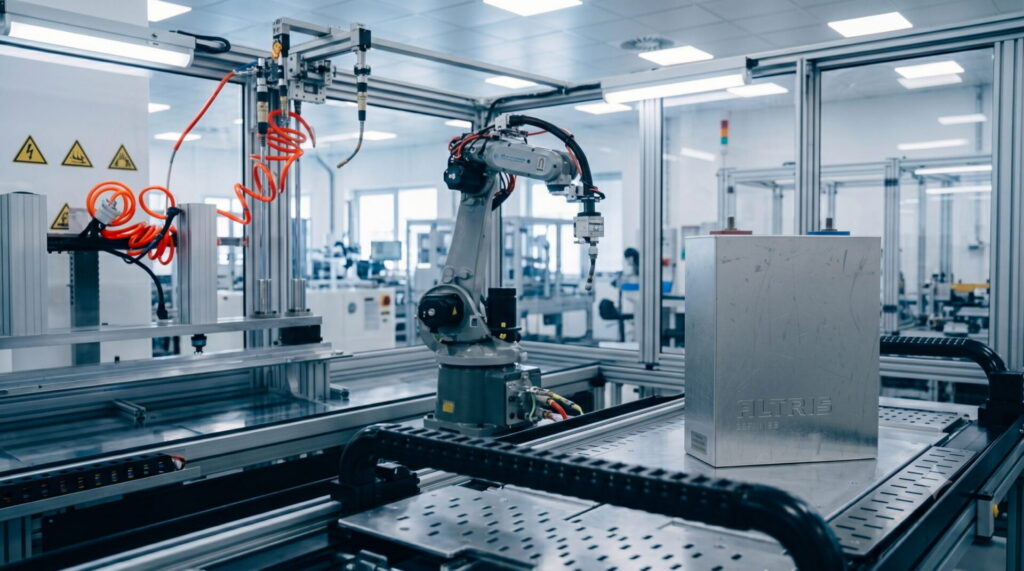
Three routes into integration with the E-Series.
01
Production supply
Direct purchase, scaled to volume. Standard Altris E-Series cells, off-take agreements sized to your ramp.
02
Sample access
Prototype cells for evaluation. Engineering support to integrate into your pack design and BMS.
03
Co-development
Integration partnership. Tailored cell variants for your application, shared roadmap, shared IP.
Common questions.
The E-Series is optimised for long-duration endurance applications with maximum cycle life. The P-Series is optimised for high C-rate applications requiring rapid, repeatable power delivery. Both are built on the same Prussian White cathode active material.
The Gen 1 E-Series has been validated in a 36V 12S1P system with a max discharge current of 225A and a voltage range of 1.8-3.8V per cell. Integration support and BMS guidance are available from our engineering team.
No. Altris sodium-ion cells are classified as Non-Dangerous Goods (Class 9 Exempt) and can be stored and shipped at 0 volts.
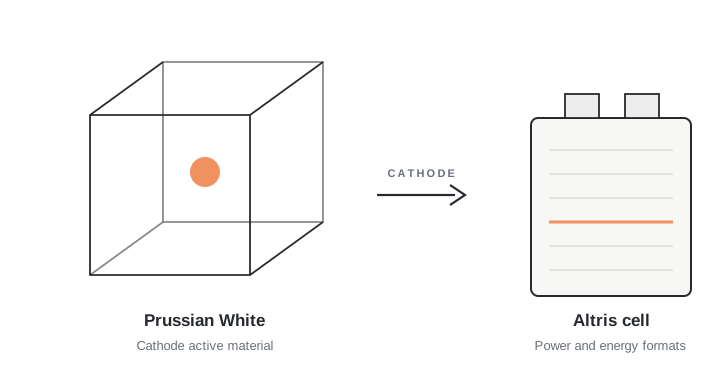
Built on Altris’ proprietary CAM
Our Prussian White powers both Power and Energy applications.
The E-Series uses the same Prussian White cathode active material as the P-Series – iron and sodium, manufactured in Czechia from European raw materials. One chemistry, two cell formats, every market segment.